
Sector
Cultural fit-out specialists
Galleries, museums and heritage interiors handled with care.
Sector overview
We install feature ceilings, acoustic systems and fit-out trades in galleries, museums, heritage interiors and publicly accessible cultural buildings across the UK. The specification brief in cultural environments combines a higher architectural finish standard, where the ceiling is often part of the design rather than a neutral background, with precise acoustic and conservation requirements that drive system selection well beyond standard commercial mineral fibre tile. We work as a specialist trade contractor to the principal contractor or directly to the cultural operator on smaller scope refurbishments.
Cultural environments we work in
We install ceiling systems, acoustic interventions and fit-out trades across the UK cultural sector: galleries, museums, heritage interiors, visitor centres, arts centres and publicly accessible university and civic cultural buildings. The sector ranges from small regional museum gallery refurbishments, where the scope is a single ceiling and acoustic package, to large multi-phase projects where a principal contractor runs the wider building programme and we deliver the ceiling, acoustic and feature ceiling specialist trades.
Cultural buildings carry an unusual ceiling specification brief. The ceiling is often an architectural element in its own right: the design intent is typically for the ceiling to contribute to the visitor experience, frame the exhibit, or demonstrate the character of the building, rather than to function as a neutral surface. At the same time, acoustic performance, lighting integration and, in some cases, conservation environmental compatibility must all be satisfied alongside the architectural intent. The result is a specification that sits significantly above standard commercial office or retail ceiling work.
Compliance priorities
Acoustic performance in cultural spaces is driven by the client's operational brief rather than a single mandatory standard. The relevant guidance is BS 8233:2014, the UK Design Guide for Sound Insulation and Noise Reduction for Buildings, which provides reference values for reverberation time by space type. Gallery circulation areas, café and restaurant spaces within museums, and interpretation theatres each have different reverberation time targets, and the ceiling and wall specification needs to be coordinated with the acoustic consultant's model to achieve them.
Lighting integration is a parallel technical requirement. Gallery ceiling specifications must accommodate track lighting systems, conservation-grade luminaires, and programmable control infrastructure. The ceiling carrier system, plenum zone height and tile or panel demountability determine what M&E integration is achievable. Coordinating the lighting specification with the ceiling system at design stage (not after the ceiling grid has been set) is essential.
Where conservation environmental management is part of the building brief, ceiling system compatibility with the environmental control strategy should be confirmed. Certain mineral fibre tile systems can absorb and release moisture under relative humidity cycling; stone wool and glass wool products typically have better dimensional stability under controlled RH variation.
What we install in cultural spaces
Suspended ceilings provide the background to gallery circulation, staff and back-of-house areas, and support spaces within cultural buildings, typically higher-specification mineral fibre tile in concealed-grid or shadow-gap formats, or solid panel systems in public-facing areas. Higher light reflectance values from white-faced tile are specified in gallery circulation where the lighting strategy depends on ceiling reflectance.
Free-hanging acoustic rafts and baffles, principally Ecophon Solo, are the acoustic intervention of choice in open gallery volumes, café and restaurant spaces, and entrance halls where reverberation control is required but an enclosed ceiling plane is not the architectural intent. Rafts hang flat and absorb from below; baffles hang vertically for higher absorption per unit of floor area in very large volumes.
Acoustic wall panelling (Ecophon Akusto, or comparable fabric-wrapped absorbers) provides wall-level absorption in interpretation rooms, intimate gallery spaces and any enclosed space where the ceiling height limits ceiling-plane absorption.
Timber ceilings (Hunter Douglas solid linear timber and similar systems) are the dominant architectural ceiling specification in higher-specification cultural public space: museum walkways, gallery entrance halls, visitor reception areas and arts centre public foyers.
Metal ceilings (SAS International metal panel systems and Hunter Douglas 84R and Heartfelt) provide the metal-language ceiling specification in higher-specification cultural environments, including transport-adjacent cultural venues and exhibition spaces where the material palette calls for metal rather than timber.
Documented project experience
At the Northampton Museum and Art Gallery, we installed Ecophon Solo Rectangle rafts in the shoe gallery and café, providing acoustic absorption in the public gallery spaces without introducing an enclosed ceiling plane, and Hunter Douglas Heartfelt to the main walkway as the architectural and acoustic finish to the primary public circulation route. The two systems (glass wool free-hanging rafts and felt baffle ceiling) together address the acoustic brief while reading as designed architectural elements rather than functional ceiling products.
At the Aston Student Union in Birmingham, we installed Ecophon Solo rafts sloped to the structural roof in the main social space alongside Hunter Douglas solid linear timber to the ground floor: a coordinated acoustic and architectural ceiling package in a high-occupancy public-space environment with a strongly architectural design intent.
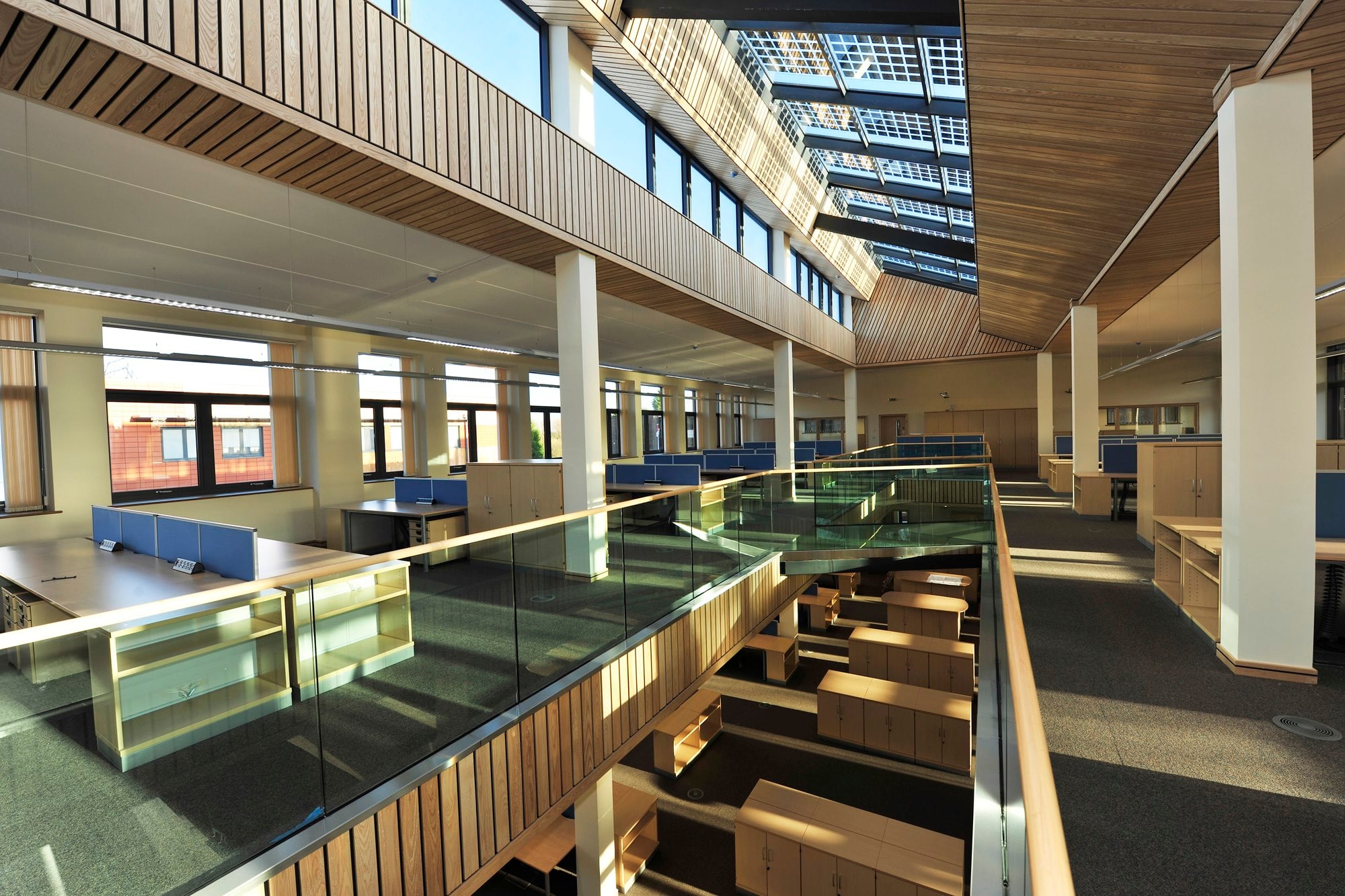
At the British Geological Survey James Hutton Building in Keyworth (a Natural Environment Research Council research facility open to public engagement), we installed Hunter Douglas solid linear timber as the feature ceiling to the higher-specification interior: a research environment with a publicly accessible character that sits in the cultural-adjacent specification space.
How we work on cultural projects
Most of our cultural sector work is delivered as a specialist trade subcontractor to a principal contractor running the wider building or refurbishment programme. We attend pre-construction meetings, provide the relevant RAMS, agree the phasing and exclusion zone plan with the curator and facilities team, and install with noise and dust control appropriate to a public or semi-public environment.
On smaller scope refurbishments, whether a single gallery ceiling replacement, an acoustic package in a café or interpretation room, we sometimes work directly to the cultural operator or museum facilities team and manage our trade scope as principal contractor.
If you are scoping a ceiling, acoustic or feature ceiling package in a cultural building, whether a gallery refurbishment, museum café acoustic treatment, or a feature timber or metal ceiling in a public-facing space, we would be glad to discuss the brief. Send drawings, the architect's RCP or the acoustic consultant's reverberation targets with the form on this page and we will come back with a clear next step quickly. For urgent enquiries call 01332 757830 or email enquiries@eastledge.co.uk.
Our approach
We treat cultural projects as specification-led work where the ceiling is part of the architectural intent, not a functional commodity. Pre-construction coordination covers the lighting and services integration, plenum access requirements, acoustic modelling alignment, and any conservation environmental compatibility checks for the ceiling system. We work to the architect's RCP and the acoustic consultant's reverberation targets with the same rigour we apply to the acoustic brief in education and healthcare. Our documented cultural project experience covers free-hanging Ecophon Solo rafts and baffles in gallery, factory and university social environments, Hunter Douglas Heartfelt and solid linear timber as architectural finishes in museum and higher education cultural spaces, and SAS metal systems in public-space environments. Specification is always manufacturer-agnostic: system selection follows the architect's design brief, the acoustic target and the conservation environmental requirement.
Our work
Cultural projects
Sector challenges
What makes cultural interiors different
Architectural finish on the ceiling plane
In galleries and cultural spaces, the ceiling is frequently a designed element rather than a functional background. Feature timber, metal plank, free-hanging rafts and bespoke panel systems are specified where a standard lay-in tile would not meet the architect's or curator's intent.
Acoustic control in open volumes
Large gallery volumes, entrance halls, restaurant and café spaces within cultural buildings generate significant reverberation under public occupation. Reducing reverberation time without introducing visible acoustic treatment that compromises the exhibit or architectural reading requires careful system selection, free-hanging rafts and baffles, or acoustic-faced feature panels.
Conservation environmental requirements
Certain exhibition spaces have temperature and relative humidity control requirements that directly affect ceiling system selection. Some mineral fibre tile systems are not appropriate where conservation-grade climate control is specified. System compatibility with the building's environmental management strategy needs to be confirmed at specification stage.
Lux-level sensitivity and lighting integration
Gallery ceiling specifications must integrate with the lighting strategy, track lighting, gallery spotlights, conservation-grade UV-filtered luminaires and programmable dimmers require coordination with the ceiling carrier system, plenum access, and the reflectance specification of the ceiling face.
Working in operational or heritage buildings
Cultural venues, particularly national and regional museums, are frequently open to the public during refurbishment. Programme phasing around public access, protection of exhibits and finishes during installation, dust and noise control, and secure compound management are standard requirements.
Curator and facilities team coordination
Cultural clients often involve the curator or collections team in the specification sign-off alongside the architect and QS. Installation within or adjacent to collection areas requires specific agreed protocols for exhibit protection and access management during works.
Featured projects
Recent cultural work
Services we offer
Disciplines we apply for cultural clients
Suspended Ceilings
Modular grid and tile systems engineered for acoustic, fire and lighting integration.
Acoustic Rafts & Baffles
Suspended absorbers for open plenums and exposed-services interiors.
Acoustic Panelling
Wall-mounted absorption that controls reverberation in busy commercial spaces.
Timber Ceilings
Linear, slatted and panelled timber for warmth, scale and acoustic quality.
Metal Ceilings
Plank, tile and bespoke metal systems for high-traffic and architectural interiors.
Manufacturers
Systems we recommend in this sector
FAQs
Frequently asked questions
Get in touch
Planning a cultural project?
Tell us about the brief and the constraints. We'll come back with a clear next step quickly.