
Service
Timber Ceilings
Specialist timber ceiling installers, established 1986
What we do
We design, supply and install timber ceiling systems across the UK: Décor Acoustics systems for new commercial timber ceiling work, Hunter Douglas solid linear timber for higher-specification education and cultural interiors, and bespoke feature timber for reception, public and display spaces. Forty years of in-house fixing sequenced into your fit-out or refurbishment programme.
What timber ceilings cover
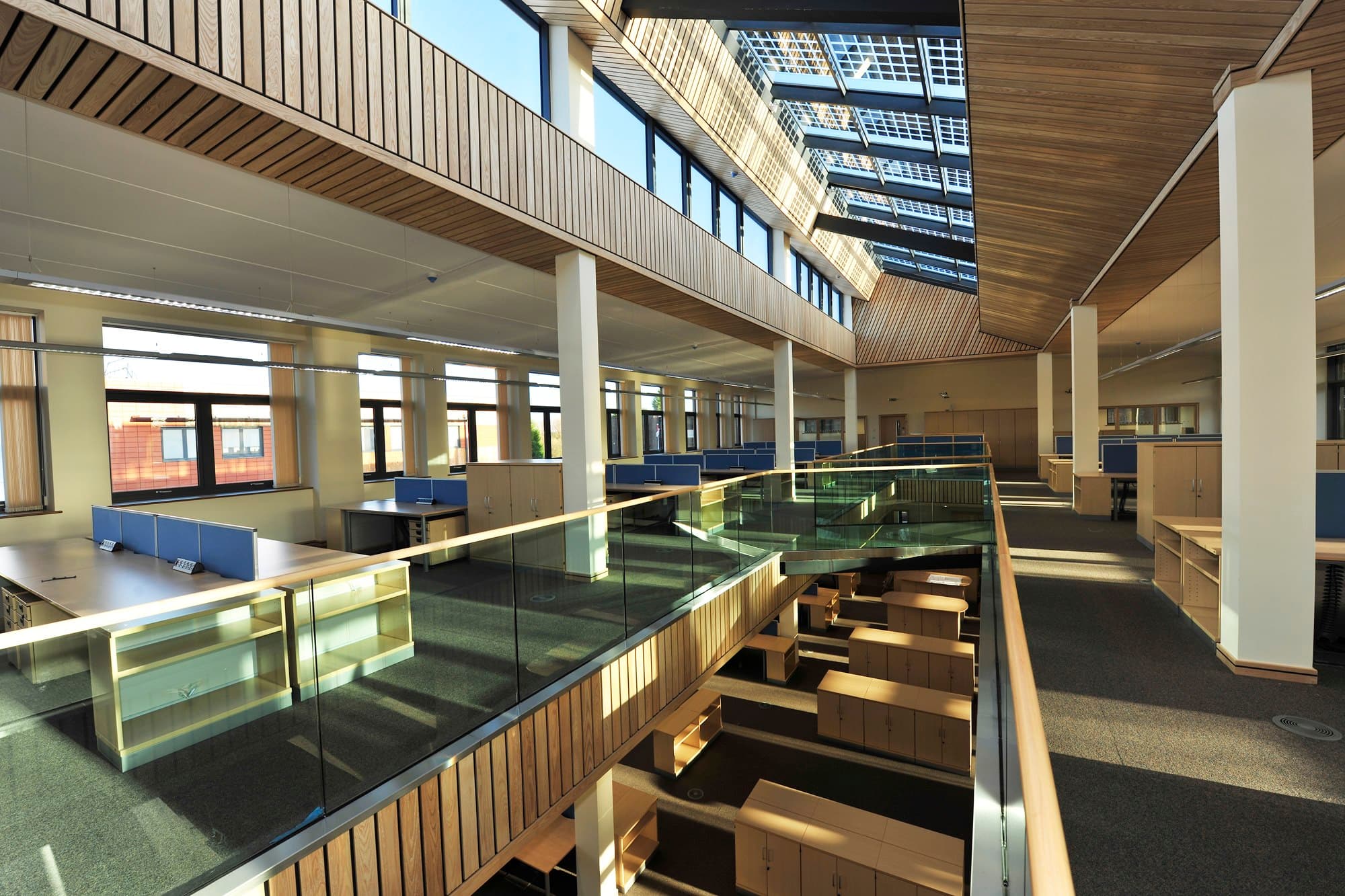
Timber ceilings cover the full spectrum of suspended and surface-fixed ceiling systems using real or engineered wood as the visible finish: open-cell slatted timber (parallel battens with open joints, acoustic backing in the void), solid linear timber (close-jointed planks presenting a continuous wood face), perforated and slotted acoustic timber (wood face with a pattern of holes or slots through to an acoustic backing) and bespoke feature timber in custom geometry. The category sits at the higher-specification end of the commercial ceiling market, used in spaces where the warmth and material language of real or engineered wood is part of the architectural brief rather than a commodity specification choice.
Timber ceilings are most commonly specified in higher education teaching and social areas, cultural buildings (museums, galleries, libraries, theatres), corporate reception and boardrooms, hospitality (hotels, restaurants, food and beverage), transport interchanges, and any commercial interior where the design intent is to combine natural material language with the practical function of a suspended ceiling system. They are almost never the lowest-cost ceiling option, but they are routinely the right architectural answer in premium-specification interiors.
Where each timber type fits
For new timber ceiling projects where the specification is open to a manufacturer recommendation, Décor Acoustics is our principal partner. Décor's range covers open-cell slatted, acoustic perforated and bespoke feature timber systems and is the starting point for most of the new timber ceiling work we scope. We also install Hunter Douglas solid linear and Heartfelt for projects where those systems have been nominated by the architect or specifier.
Open-cell slatted timber is the most widely specified timber ceiling category across the commercial market. Parallel battens at consistent spacing on a concealed carrier present a linear, airy visual language with material depth and shadow detail that neither mineral fibre nor metal can reproduce. The open joint allows the void above to breathe (useful where the ceiling is alongside an HVAC supply air arrangement) and exposes the acoustic backing (mineral wool or PET felt) to the room, which delivers absorption through the open-cell gap. Open-cell timber is used in corporate offices, higher education social and circulation space, and hospitality environments. Décor Acoustics supply open-cell and slatted systems as part of their core range.
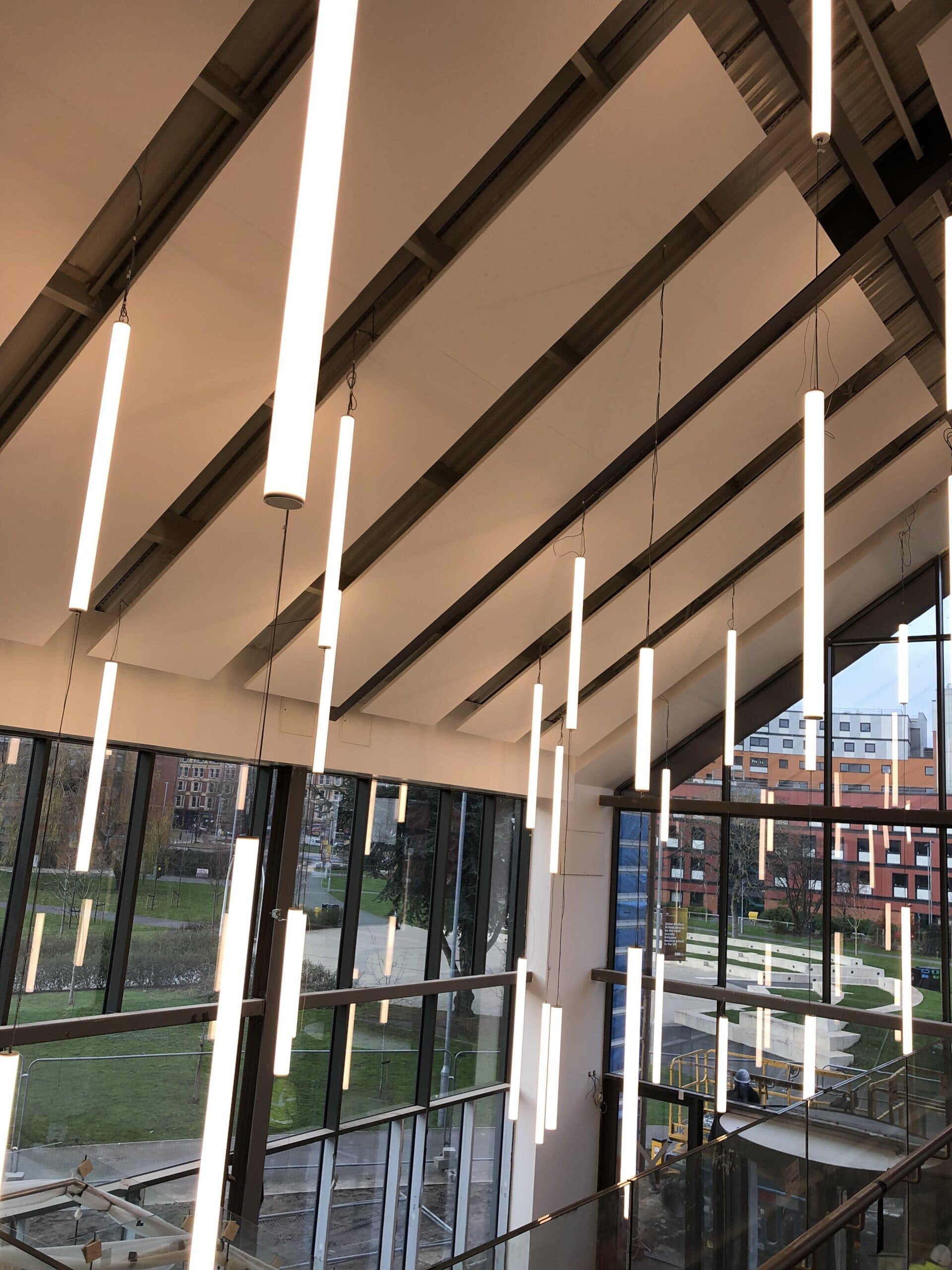
Solid linear timber (such as Hunter Douglas solid linear) presents a close-jointed or tongue-and-groove face with no visible gaps between planks: a warmer, richer, more monolithic finish than slatted timber, used in higher-specification lobbies, student union social space and cultural interiors where the material quality of a continuous wood face matters. The trade-off against open-cell is that solid timber is inherently non-acoustic (solid panels reflect rather than absorb), so where reverberation control is part of the brief, supplementary acoustic panels (Ecophon Solo rafts or baffles, for example) are typically combined with the timber ceiling to deliver the absorption that the solid face cannot. We have installed Hunter Douglas solid linear timber at Aston Student Union in Birmingham (ground floor feature ceiling alongside Ecophon Solo rafts in the social space above) and at the British Geological James Hutton Building in Keyworth, Nottinghamshire.
Perforated and slotted acoustic timber combines the visual language of a wood face with a functional acoustic surface: holes or slots through the timber face expose a mineral wool or PET felt backing to the room, which provides absorption at a level determined by the perforation pattern (open area percentage and hole size), the backing material and the backing thickness. Published αw values vary by system; Class B and Class A absorption are both achievable with the right specification. Perforated acoustic timber is the answer where the architect wants timber as the ceiling finish and the acoustic consultant needs absorption that the solid face cannot provide. It costs more than open-cell slatted (the perforation and backing are additional process steps) and typically slightly less than solid linear.
Bespoke feature timber covers made-to-order architectural timber in custom geometry: curved, faceted, polygonal and free-form shaped ceilings where the design intent is a one-off feature rather than a repetitive plank or batten system. Bespoke timber is the most expensive category, carries the longest lead times, and is specified for one-off public and institutional spaces where the ceiling is a significant design gesture.
Acoustic performance of timber ceilings
Timber ceilings and acoustic performance intersect in three ways, and the right specification depends on how large a contribution the ceiling itself needs to make to the room's acoustic brief.
First, open-cell slatted timber delivers moderate absorption through the open joint: the exposed acoustic backing visible through the gaps absorbs sound that passes through the gap into the void. The contribution depends on the open area (the ratio of gap to batten width) and the backing product; published αw values for open-cell slatted are typically Class B or Class C.
Second, perforated and slotted acoustic timber delivers higher absorption by increasing the open area (perforation rather than gap) and using a high-performance backing (mineral wool or PET felt at 50 mm or more). Well-specified systems reach Class A (αw 0.90 to 1.00), which is the same performance category as Ecophon Solo or Rockfon performance tile. This makes perforated acoustic timber a viable primary acoustic surface in medium-volume rooms (meeting suites, dining areas, seminar rooms) where the visual and acoustic briefs are equally important.
Third, solid unperforated timber is effectively non-absorptive: it reflects sound at essentially the same rate as a plasterboard or metal surface. Where the acoustic brief requires reverberation control in a room specified with solid linear timber, supplementary free-hanging acoustic products (Ecophon Solo rafts or baffles, Akusto wall panels) are combined with the timber ceiling to provide the absorption. This is the design approach we have used at Aston Student Union (solid linear timber at ground floor, Ecophon Solo rafts in the social space above) and at Northampton Museum and Art Gallery (Ecophon Solo Rectangle rafts in the shoe gallery combined with Hunter Douglas Heartfelt felt-and-timber on the main walkway).
Fire performance of timber ceilings
Reaction-to-fire of solid natural timber is typically Euroclass D-s2,d0 under EN 13501-1, significantly below the Euroclass A1 or A2-s1,d0 of mineral fibre and metal ceilings. This is the principal constraint on timber specification in commercial interiors: Building Regulations Approved Document B sets minimum reaction-to-fire requirements for ceiling surfaces in escape routes, high-occupancy public spaces and certain building types, and solid natural timber typically fails to meet those requirements without treatment.
Three approaches are used in practice. First, fire-retardant treatment of the timber face (typically intumescent coating or impregnation) can achieve Euroclass B or better, which satisfies most commercial building Approved Document B requirements. Most major manufacturers (including Hunter Douglas) supply pre-treated timber products or specify the appropriate treatment system for their product. Second, a fire-rated plasterboard membrane above the timber ceiling can provide the compartmentation function, with the timber ceiling acting as a decorative layer rather than a structural fire barrier. Third, zone-by-zone specification uses timber in areas where the fire strategy permits it (social space, café, reception) and mineral fibre or metal elsewhere (escape routes, plant rooms, clinical areas). We confirm fire strategy compliance at pre-specification stage, before the timber system is committed to procurement.
Sectors we deliver timber ceilings for
In higher education, timber ceilings appear in student union social areas, learning commons, library and library café, lecture theatre lobbies, and feature circulation spaces where the institutional brief calls for a warmer, more welcoming material language than mineral fibre. Our documented higher education timber ceiling work includes the Aston Student Union ground floor (Hunter Douglas solid linear) and the University of Nottingham (Décor feature timber ceilings) delivered on main contractor programmes.
In cultural buildings, timber ceilings combine material warmth with acoustic and fire performance across museum galleries, theatre foyers, library reading rooms and gallery circulation. The Northampton Museum and Art Gallery installation combined Ecophon Solo Rectangle rafts, Hunter Douglas Heartfelt felt-and-timber and Ecophon acoustic ceiling tile across the shoe gallery, café and main walkway: a higher-specification combined acoustic and material scheme.
In corporate and transport environments, solid linear timber and slatted open-cell systems appear in reception, boardroom and VIP lounge specification, and in transport interchange public concourse specification where a premium material language is combined with Class A1 or A2 reaction-to-fire requirements (addressed through fire-retardant treatment).
In hospitality and leisure, timber ceilings are standard specification in premium restaurant, hotel lobby and food and beverage interiors where natural materials define the experience.
Why Eastledge for timber ceilings
We have been installing commercial ceilings since 1986, working from our Derby head office and delivering across the UK. Timber ceilings sit inside our ceiling specialism and are delivered by the same crews that install mineral fibre, metal and acoustic systems, which means the timber package is sequenced into the wider fit-out programme by people who understand M&E integration, fire-strategy compliance and the handover to the principal contractor. We employ our own fixers and supervisors directly.
Décor Acoustics is our principal partner for new timber ceiling work. For projects where the specification is open, we lead with Décor's range and recommend the system best matched to the project's acoustic, fire, demountability and visual requirements. We also install Hunter Douglas solid linear timber (documented at Aston Student Union and the British Geological James Hutton Building) and Hunter Douglas Heartfelt felt-and-timber (Northampton Museum and Art Gallery), and we remain system-led rather than tied to a single supplier. Specification is guided by the manufacturer's technical documentation, confirmed fire strategy compliance at pre-specification stage, and the acoustic consultant's brief.
If you are scoping a timber ceiling installation (open-cell slatted, solid linear, perforated acoustic timber or bespoke feature timber), we would be glad to discuss the brief. Send drawings, the architect's RCP or a few site photos with the form on this page and we will come back with a clear next step quickly. For urgent enquiries call 01332 757830 or email enquiries@eastledge.co.uk.
Our work
Timber Ceilings projects
Why Eastledge
What you can expect
Décor Acoustics -- our principal timber ceiling partner
Décor Acoustics is our lead manufacturer for new timber ceiling work, with documented installations at the University of Nottingham and commercial office projects across the Midlands.
Linear, slatted, open-cell and bespoke geometry
From standard slatted plank through solid linear and made-to-order shaped timber, installed to the architect's RCP.
Acoustic timber for combined performance
Perforated and slotted timber with mineral wool or felt backing delivers Class A absorption alongside the warmth of natural wood.
Direct labour, in-house programming
Our own time-served fixers and supervisors, not rotated subcontracted teams.
National coverage from the Midlands
Crews mobilised from our Derby HQ delivering timber ceilings across England, Wales, Scotland and Northern Ireland.
Forty years of repeat fit-out work
Established 1986, on principal-contractor frameworks and direct client retainers across education, cultural, corporate and transport sectors.
Featured projects
Selected work using this service
 education
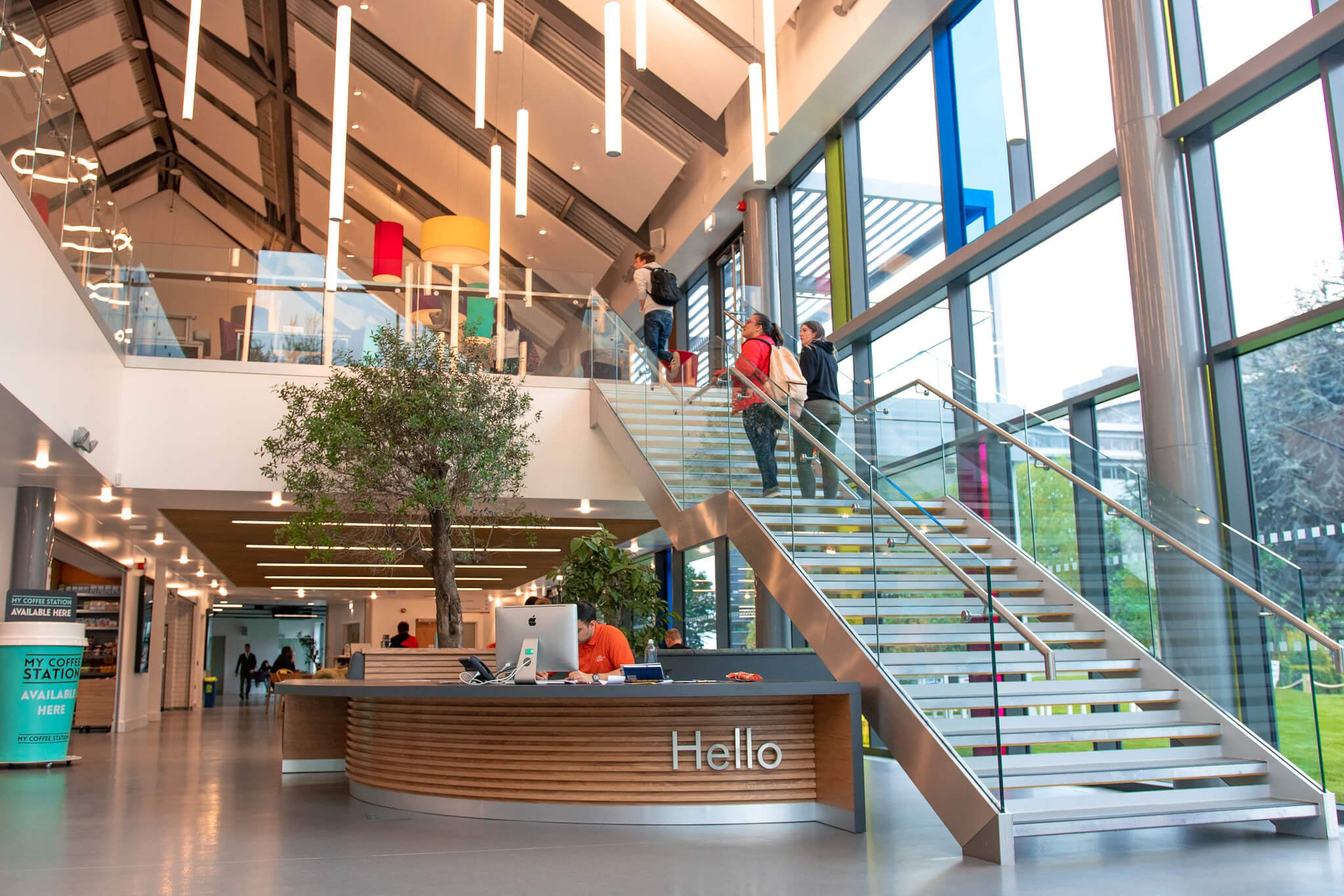
Aston Students' Union: Acoustic Rafts and Timber Ceiling Refurbishment
Aston University Students' Union · Birmingham, West Midlands
Phased refurbishment of Aston University Students' Union, Birmingham. Sloped Ecophon Solo acoustic rafts in the upper social space matched to the roof geometry; Hunter Douglas solid linear timber ceiling at ground floor. Works phased around the building's continuous student-facing operations.
View case study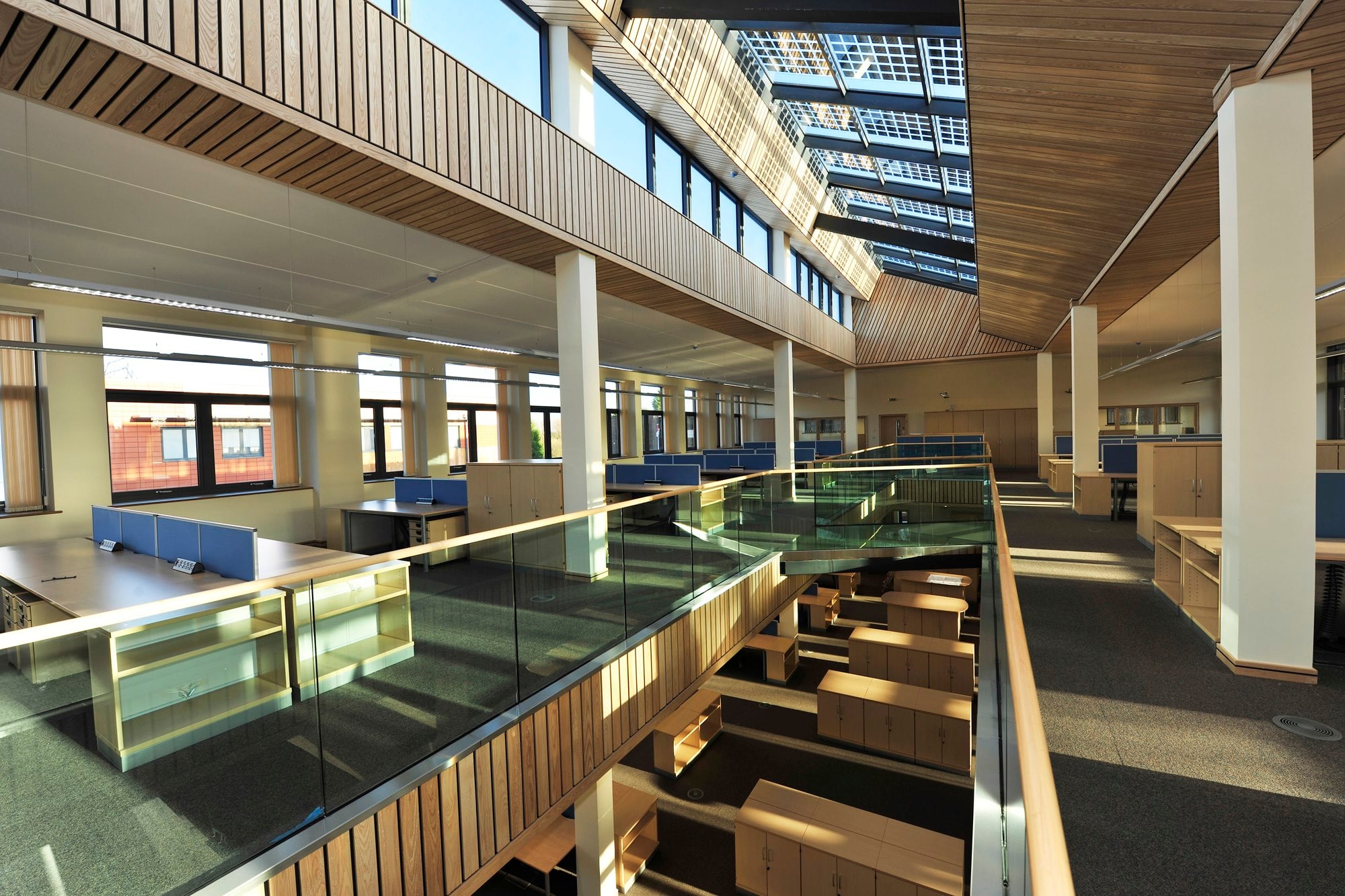 science-and-research
British Geological Survey: Hunter Douglas Timber Ceilings, Slopes and Walls
British Geological Survey · Keyworth, Nottinghamshire
Hunter Douglas solid-wood linear system installed as a continuous architectural envelope across ceilings, sloping transitions and wall panels within the James Hutton Building at the British Geological Survey's Keyworth campus. Works delivered around the occupied research environment.
View case study
Manufacturer partners
We install systems from
Sectors we serve
Timber Ceilings for these environments
- 01
Education
Schools, colleges and universities: built-environment specialists.
- 02
Cultural
Galleries, museums and heritage interiors handled with care.
- 03
Offices
Cat A and Cat B fit-out for occupier and landlord projects.
- 04
Retail
Brand-aligned shopfits, refurbishments and rolling programmes.
- 05
Leisure
Gyms, hotels, food and beverage delivered to brand and timeline.
Where we work
Timber Ceilings across the UK
We deliver this service nationwide. Browse city-specific information for our priority regions.
FAQs
Frequently asked questions
Related services
You may also need
Suspended Ceilings
Modular grid and tile systems engineered for acoustic, fire and lighting integration.
Metal Ceilings
Plank, tile and bespoke metal systems for high-traffic and architectural interiors.
Acoustic Panelling
Wall-mounted absorption that controls reverberation in busy commercial spaces.
Dry Lining
Plasterboard partitions, linings and ceilings to specification.
Commercial Fit-Out
End-to-end Cat A and Cat B fit-out, managed under one accountable contract.
Get in touch
Plan a timber ceiling installation with a specialist contractor
Send drawings, the architect's RCP or a few site photos and we'll come back with a clear next step quickly.