
Insight
Cat B fit-out sequencing: why the ceiling contractor holds the move-in date
Cat B office fit-outs run on compressed programmes with fixed move-in dates. The ceiling contractor is not the first trade on site or the last, but the sequence pivots around them. Here is how one contractor coordinating the full trade scope holds the date.
Published 29 July 2026
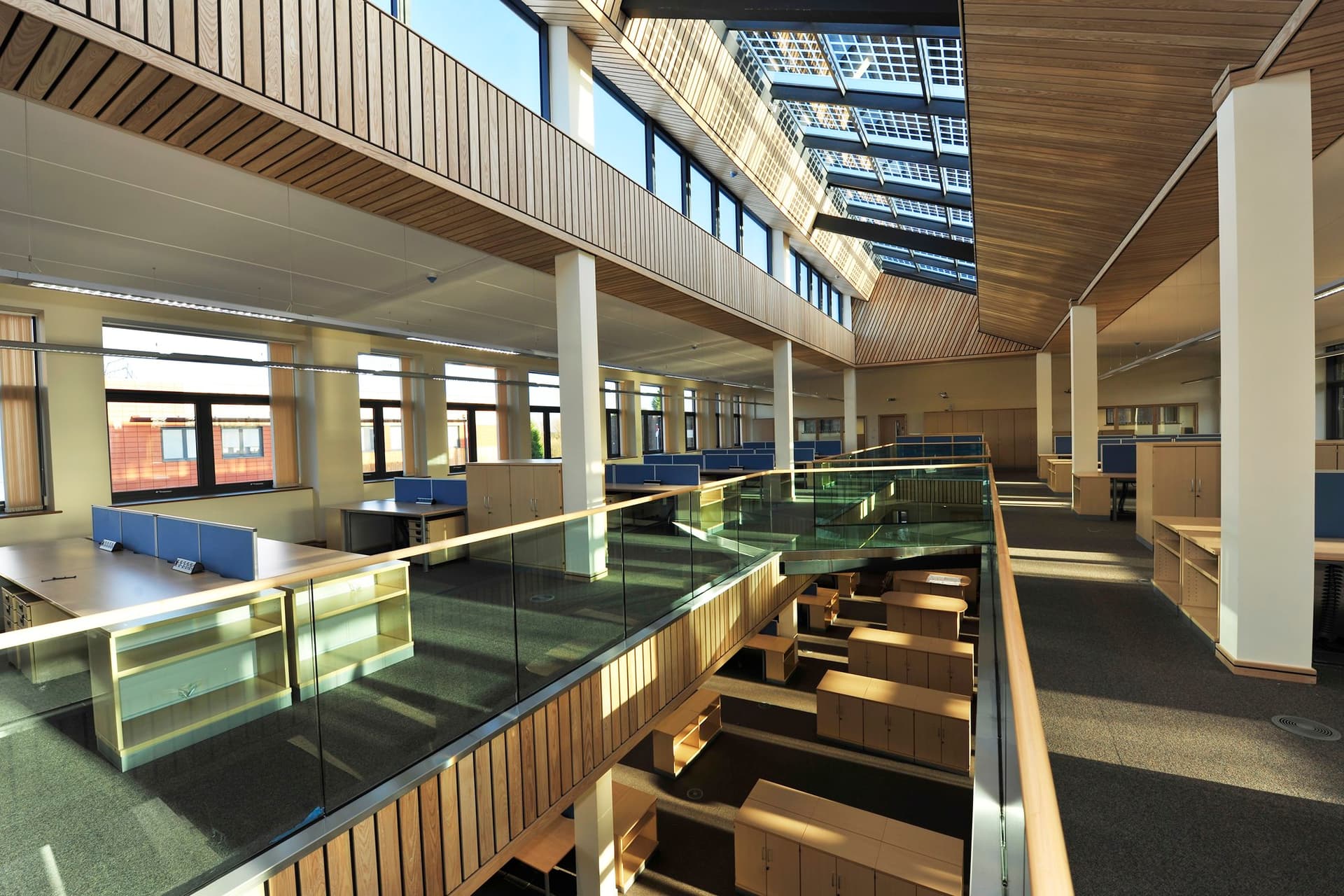
Cat B office fit-outs run on compressed programmes. The move-in date is fixed: the tenant has signed a lease that starts on a date, and the trade sequence has to run without rework. The contractor who sits at the fulcrum of that sequence is not obvious to a specifier reading a scope of works. It is not the first trade on site or the last. It is the ceiling contractor.
The Cat B trade sequence
The standard sequence runs in a fixed order. Dry lining arrives first: partitions to full height where they close the floor plate. Ceiling grid installation follows. M&E second-fix then happens above the ceiling, covering lighting, ventilation, sprinklers and cabling. Ceiling tile installation follows M&E completion. Glazed partitions land against the ceiling head next. Taping and jointing, decoration and final finishes complete the floor.
This sequence is not a preference. It is a physical necessity. Services above the ceiling cannot be second-fixed without a grid to hang from. Glazed partitions cannot land against a ceiling head detail that has not been installed. Tile installation cannot begin until every M&E penetration is complete and signed off. The order is fixed by the constraints of the build, not by any contractor's scheduling choice.
Why the ceiling contractor holds the fulcrum
The dry lining contractor closes the floor plate at the start of the sequence. The finishing trades take over at the end. Between those two bookends, the ceiling contractor is the trade that everyone else programmes around.
Ceiling grid setting-out defines the datum for two adjacent trades at the same time: it sets the service positions for M&E above and the partition head details below. Neither of those trades can finalise their own setting-out until the ceiling grid is in place. M&E cannot begin second-fix above a ceiling that has no grid. Glazed partitions cannot confirm their head detail against a ceiling that has not been installed.
If the ceiling contractor arrives late, everything downstream is late. If the ceiling contractor is ahead of M&E and the service scope has not landed, the tiles cannot go in regardless. Programme discipline on a Cat B fit-out is not about the fastest trade on site. It is about the ceiling contractor holding the middle of the sequence to the plan.
Coordinating the full trade scope under one supervisor
A Cat B fit-out procured as separate trade packages requires the principal contractor to manage the interfaces between those trades: when dry lining finishes, when the ceiling contractor arrives, when M&E second-fix begins, when tiles go in, when glazing and finishing trades mobilise. Each interface is a potential programme delay, and managing those interfaces absorbs time that the principal contractor would rather spend elsewhere.
A Cat B fit-out procured as a full trade package, with dry lining, ceilings, partitions and taping and jointing under one specialist contractor, puts the interface management on that contractor. The principal contractor retains a single point of accountability. The programme still has the same interfaces, but one party is responsible for all of them.
Eastledge delivers the full trade scope under one site supervisor as standard on Cat B offices programmes. The interfaces that the principal contractor would otherwise manage are managed internally, under the same contract and against the same programme.
In practice
The Cat A office ceiling at Pioneer Park Dock, Leicester was delivered as a perforated metal plank system with acoustic backing across a Class A lettable floorplate. The trade sequence ran grid setting-out, M&E coordination, and plank installation zone by zone against a fixed landlord handover date — the same programme discipline that a Cat B move-in date demands, applied at the Cat A stage.
Recent Cat B work includes the office fit-out at Glenair Mansfield, where the office environment was delivered alongside a separate factory acoustic programme under a single contract and single supervision team. The trade coordination discipline that held the programme there is the same discipline applied to every Cat B project: one supervisor, one dedicated team, one coordinated trade scope.
The same suspended ceiling installation in Leicester principles apply when a programme is split across multiple floors or buildings.
The commercial fit-out service page sets out the full scope Eastledge delivers across Cat A and Cat B programmes.
Taking on a Cat B programme
For Cat B office fit-out enquiries in the Midlands or North of England, talk to us about your programme. For Cat B projects where the trade interface management matters as much as the specification, the single-team approach is worth considering early.