Service
Taping & Jointing
Specialist taping and jointing for commercial dry lining packages
What we do
We deliver specialist taping and jointing across commercial dry lining packages throughout the UK, integrated with our in-house partition and lining trade. Level 3, Level 4 and Level 5 finishes delivered by dedicated operatives, sequenced into the principal contractor's programme from our Derby head office.
What is taping and jointing?
Taping and jointing (T&J) is a distinct finishing trade: the process that converts a fixed plasterboard surface into a smooth, seamless, decoratable face without applying a continuous wet coat across the entire substrate. Paper or fibreglass tape is bedded over board joints using specialist joint compound, then built up across multiple coats, feathered out to blend with the surrounding board face, and sanded flat between coats. The result is a face ready for mist coat and decoration, with joints invisible under normal lighting and at Level 4 finish under most decorative schemes.
In modern UK commercial fit-out, T&J has become the standard finishing method on metal stud partitions and plasterboard lining systems because it is faster, generates less wet material on site, and produces a commercially appropriate face for the full range of decorative finishes. Eastledge delivers T&J as a finishing trade integrated with our partition and lining work, under one site team and one supervisor, from our Derby head office.
How T&J differs from traditional plastering
T&J is the modern UK commercial default for finishing plasterboard linings. It operates on a fundamentally different principle from traditional plastering: rather than applying a continuous wet coat across the entire surface, T&J addresses the joints between boards specifically, bedding tape, building up compound in layers, feathering outward and sanding flat.
The distinction from plastering matters on programme. T&J uses much lower volumes of wet material, dries faster between coats, and allows the surface to be handed to decoration sooner. On volume commercial work, offices, schools, healthcare facilities, retail rollouts, this programme advantage is significant. T&J is also the standard method for Level 4 finish on metal stud partitions, which makes it the default specification across most commercial sectors.
Finish levels are defined in the British Gypsum White Book and widely referenced by architects and specifiers: Level 3 for textured decoration, Level 4 for standard smooth commercial decoration, Level 5 for critical-lighting environments where any joint shadow would be unacceptable. We deliver Level 4 as our commercial default and Level 5 where the specification requires it.
When taping and jointing is the right specification
T&J is appropriate wherever plasterboard is the substrate and standard commercial decoration follows. That covers the majority of modern UK commercial fit-out: metal stud partitions in offices, education and healthcare; plasterboard MF ceiling linings; corridor and back-of-house walls in retail and leisure fit-out; and welfare accommodation in industrial and warehouse interiors.
The specification case for T&J over skim plastering rests on programme and practicality. T&J uses thinner coats, dries faster, requires no scratch coat, and produces a commercially adequate face for the full range of paint and decoration finishes. On fast-track programmes, the reduced wet-trade time on site is a material advantage. Where a continuous monolithic face is specified or where the brief requires it, skim plastering remains appropriate; T&J is the commercial standard for most everything else.
Finish levels we deliver
Level 3 applies where the decoration scheme tolerates surface texture: heavy matt paint, texture coatings, or vinyl wallcoverings where the substrate variation disappears under the finish. This level is acceptable for back-of-house and welfare environments where finish quality is not a primary concern.
Level 4 is the standard for most UK commercial fit-out. The surface is flat and smooth, all joints are filled and feathered, and the face takes standard emulsion paint and light-sheen decoration without defects visible under normal diffuse lighting. This is our commercial default and the level most often specified by architects for offices, education, healthcare, retail and hospitality interiors.
Level 5 is specified where raking or critical lighting would reveal any joint shadow: executive offices with large windows, showrooms, reception lobbies with directional spotlighting, and display environments. Achieving Level 5 requires either a skim coat of finishing plaster over the jointed boards or application of a proprietary finish coat, followed by fine sanding and inspection under critical lighting before handover. We deliver Level 5 where it is specified and confirm the target at pre-start to allow the correct trade sequence and programme allowance.
Tools depend on the scope. Hand taping knives and corner tools are standard for most commercial work. On larger-volume programmes where joint length justifies equipment mobilisation, mechanical taping tools can improve productivity significantly. We use both approaches and select based on programme and scope.
How we integrate with the wider dry lining package
T&J is most productive when it runs directly behind the board-fixers as one continuous package under one site supervisor. The partition or lining frame is built; the board layers are fixed; T&J follows immediately, without a handover day or a trade-break. Decoration follows behind T&J on the same programme.
Where the same contractor delivers dry lining, T&J and the handover to decoration as a single trade sequence (as we do), snagging at the joints is eliminated, the programme runs tighter, and the single supervisor owns the quality of the finished face from frame to decoratable surface. Splitting these trades generates a handover gap: T&J operatives arrive to find boards that are not to their standard, snagging builds up at the split, and programme slips.
Our T&J work is delivered alongside our partition and suspended ceiling packages under one site team. The sequence is planned by our in-house programming team and agreed with the principal contractor's master programme before mobilisation.
Sectors and projects
In higher education, T&J follows our partition and lining work across teaching, social, library and refurbishment programmes. Our taping and jointing at Barnsley College was delivered alongside the suspended ceiling and acoustic panelling package across four levels of the refurbishment.
In industrial and commercial fit-out, T&J integrates with the partition and lining package across Cat A and Cat B office and welfare interiors. Our work at Glenair Mansfield in Nottinghamshire was delivered as part of the wider industrial fit-out alongside the dry lining and suspended ceiling packages.
In healthcare, T&J follows fire-rated and acoustic partition installation across primary care, clinical and refurbishment work: a flat, sealed face ready for hygienic decoration.
In retail and leisure, T&J supports rollout and standalone fit-out programmes alongside suspended ceilings, partitions and dry lining, with the trade sequence compressed against the brand's open date.
Compliance and standards
T&J workmanship is governed by the FIS Site Guide tolerances for plasterboard surface finish, which define acceptable deviation under a 2 m straight edge and the visual standard at handover. We work to FIS guidance on every project.
Joint compound specifications follow the manufacturer's published system documents: British Gypsum (Gyproc jointing compound range), Knauf and Siniat all publish compound selection guides for standard, accelerated and high-performance jointing applications. We install to the relevant manufacturer specification on every project.
The Gypsum Industries Federation and the relevant sections of the British Gypsum White Book provide the reference for finish levels and the acceptance criteria for each.
Get in touch
If you are scoping a taping and jointing package as part of a dry lining or complete fit-out scope, we would be glad to discuss the brief. Send drawings, the architect's finish specification or a few site photos with the form on this page and we will come back with a clear next step quickly. For urgent enquiries call 01332 757830 or email enquiries@eastledge.co.uk.
Why Eastledge
What you can expect
Finishing trade integrated with dry lining
T&J sequenced with our partition and lining work under one site team and one supervisor, with no handover gap between board-fixing and finished decoratable face.
Level 4 and Level 5 capability
Standard Level 4 commercial finish as the default; Level 5 finish for executive office, critical-lighting and showroom applications where shadow-free flatness is required.
Tested system specifications
British Gypsum, Knauf and Siniat approved joint compound systems, installed to the manufacturer's published specification throughout.
Direct labour, in-house programming
Our own time-served operatives and supervisors, not rotated subcontracted teams.
National coverage from the Midlands
Crews mobilised from our Derby HQ delivering taping and jointing across England, Wales, Scotland and Northern Ireland.
Forty years of repeat fit-out work
Established 1986, on principal-contractor frameworks and direct client retainers across higher education, healthcare, retail and corporate sectors.
Featured projects
Selected work using this service
 education
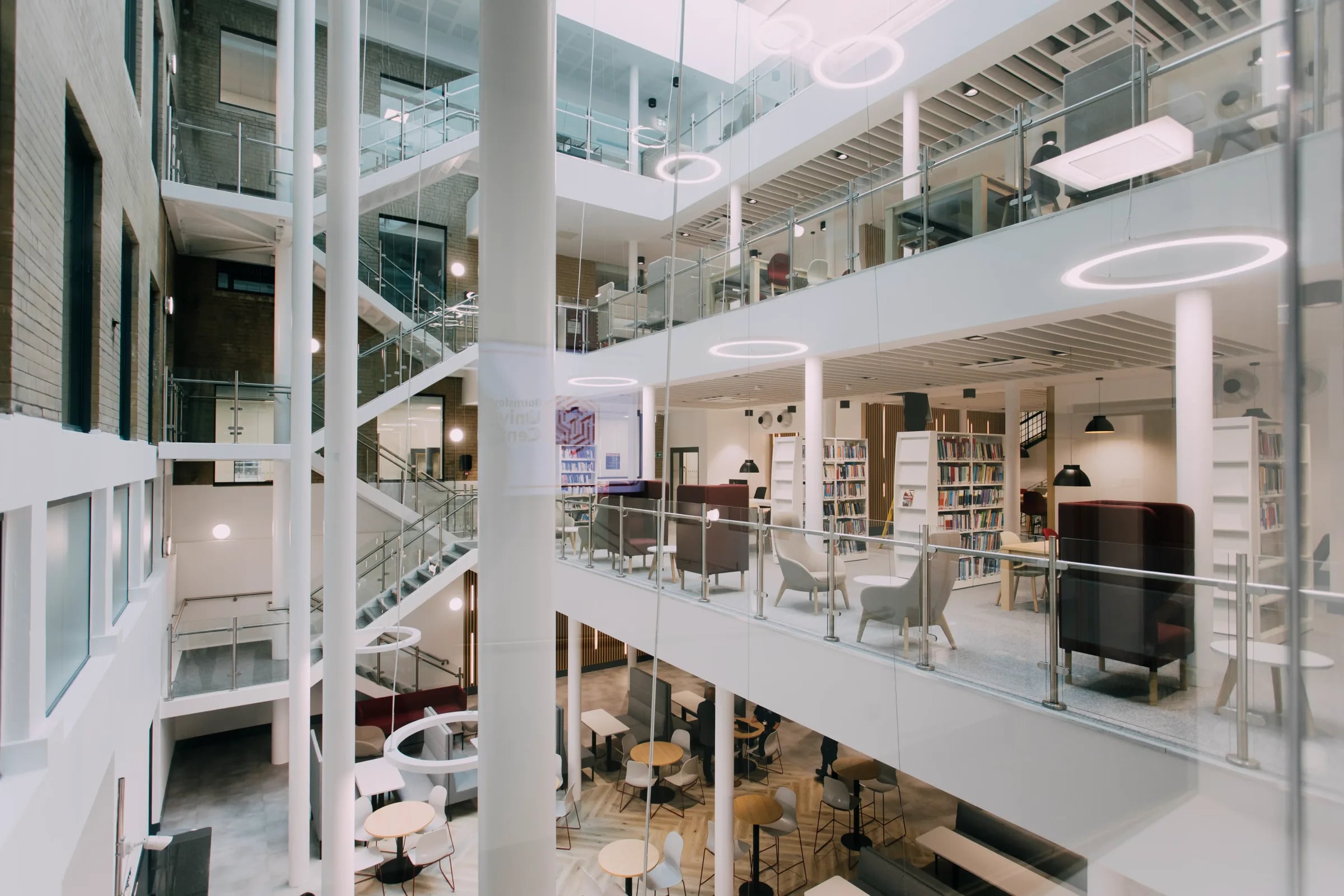
Barnsley College: full refurbishment across four levels
Barnsley College · Barnsley, South Yorkshire
A year-long refurbishment of four levels at Barnsley College, delivering suspended ceilings, acoustic hanging panels and a full acoustic package across classrooms, atrium and circulation spaces.
View case study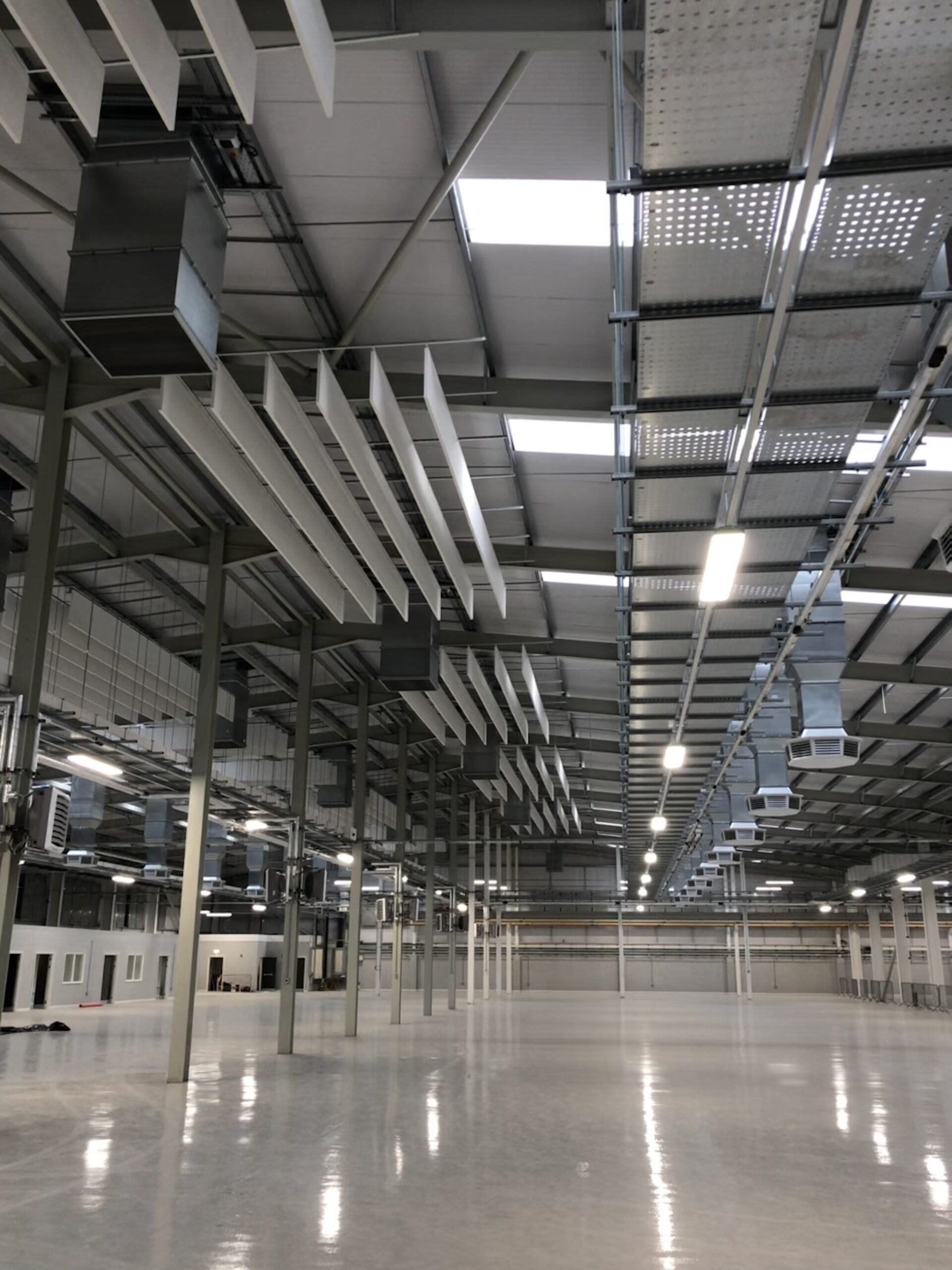 industrial
Glenair Mansfield: Office Fit-Out and Factory Acoustic Strategy
Glenair UK Ltd · Mansfield, Nottinghamshire
Combined office fit-out and factory acoustic strategy for Glenair's UK Mansfield site. Office ceilings in Zentia Ultima OP with 15 mm Silhouette grid and black reveal; over 900 Ecophon Solo baffles in the factory production hall, fitted before machinery installation.
View case study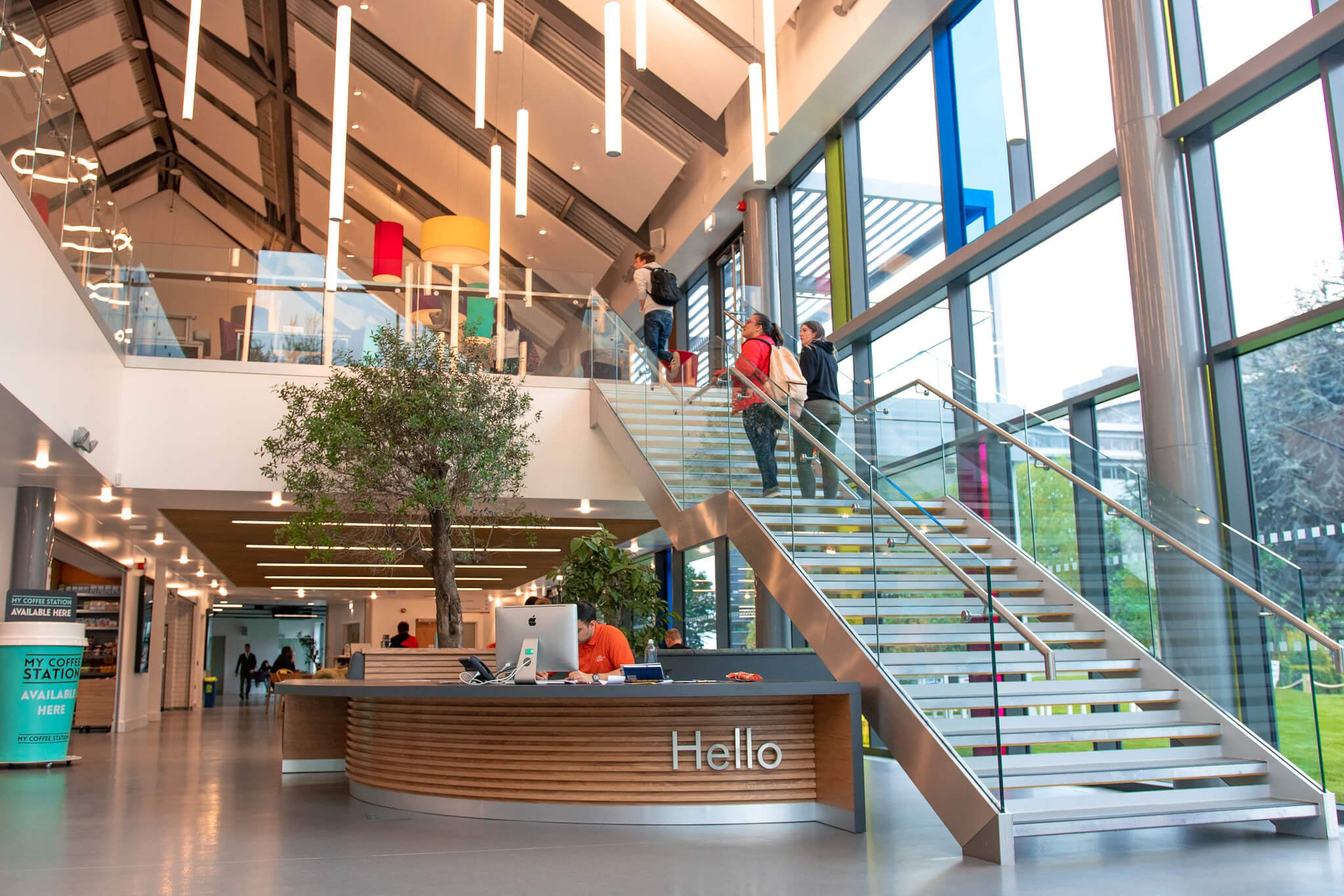 education
Aston Students' Union: Acoustic Rafts and Timber Ceiling Refurbishment
Aston University Students' Union · Birmingham, West Midlands
Phased refurbishment of Aston University Students' Union, Birmingham. Sloped Ecophon Solo acoustic rafts in the upper social space matched to the roof geometry; Hunter Douglas solid linear timber ceiling at ground floor. Works phased around the building's continuous student-facing operations.
View case study
Manufacturer partners
We install systems from
Sectors we serve
T&J for these environments
Where we work
T&J across the UK
We deliver this service nationwide. Browse city-specific information for our priority regions.
FAQs
Frequently asked questions
Related services
You may also need
Dry Lining
Plasterboard partitions, linings and ceilings to specification.
Partitions
Solid, glazed and demountable partitions for offices, education and healthcare.
Commercial Fit-Out
End-to-end Cat A and Cat B fit-out, managed under one accountable contract.
Suspended Ceilings
Modular grid and tile systems engineered for acoustic, fire and lighting integration.
Get in touch
Plan a taping and jointing package with a specialist dry lining contractor
Send drawings, the architect's finish specification or a few site photos and we will come back with a clear next step quickly.